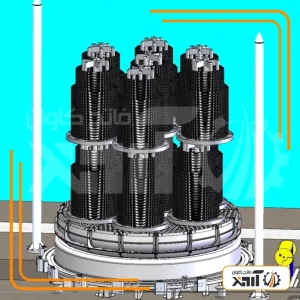
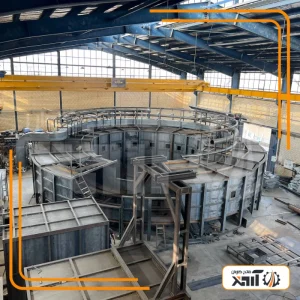
One of the newest generations of furnaces is the protective gas heat treatment furnace. These furnaces offer many advantages and, due to their special structure, are considered among the more environmentally friendly types of furnaces. Fateh Kavan Arvand is one of the leading suppliers of this type of furnace in the country. In this article, we aim to explain this type of furnace and introduce it in a complete and comprehensive manner.
Protective gas heat treatment furnaces are manufactured either as a continuous chamber or tunnel-type furnace, and a retort is also used in them. These furnaces are used in the production of stainless steel and for heating certain special components. They are highly useful whenever parts need to achieve significant resistance against oxidation and discoloration.
Protective atmosphere heat treatment furnaces are among the most widely used furnaces in various heat treatment processes involving a protective atmosphere. These furnaces, which are used to prevent the oxidation of steel parts inside the furnace heating chamber, have a wide range of designs in terms of furnace geometry, mechanisms, mechanical and sealing components, protective gas generation systems, steel structure, and control and instrumentation equipment. Another application of these furnaces is the brazing process.
Apart from vacuum furnaces, which will be discussed in another article, nitrogen and argon gases are used in protective atmosphere heat treatment furnaces to purge the oxygen atmosphere inside the chamber.
A question that may arise here is why the use of protective gas heat treatment furnaces has increased. The reason relates to the high cost of inert gases. One of the best ways to prevent scaling of parts and decarburization of steel surfaces is to use inert gases. These gases do not create a chemical reaction with the hot steel parts placed inside the furnace, and in this way the steel and steel components do not undergo decarburization. However, since these gases are expensive, using them for such operations is costly, which has limited their application.
To solve this problem and prevent decarburization of steel surfaces, furnaces known as heat treatment furnaces have been used over the past years. These furnaces are also called controlled atmosphere furnaces. The early and initial models of these furnaces are referred to as pit-type furnaces.
If we compare these furnaces with salt bath furnaces, it should be said that heat treatment furnaces have many advantages, one of which is that they do not pollute the environment. These furnaces are equipped with sensors that make it possible to control carbon activity and the furnace atmosphere much more accurately and effectively.
Despite their valuable advantages, their disadvantages should not be overlooked. One of the most important drawbacks of these furnaces is that in the interval between removing the parts from the furnace and placing them into the quench tank, the parts undergo oxidation. To solve this problem, furnaces known as sealed quench atmosphere controlled furnaces were invented.
In sealed quench atmosphere controlled furnaces, the furnace is connected to the quenching environment, and after the parts leave the furnace, they enter the quenching medium in the shortest possible time. During this interval, the parts are also protected by protective gases.
Protective atmosphere furnaces have a sealed metallic chamber made of heat-resistant steel (retort), and temperature-generating equipment such as heating elements or burners is installed behind the retort. One of the most important points in designing these furnaces is ensuring that the heating chamber is fully sealed against gas leakage to the outside or oxygen penetration into the heating chamber. Naturally, in chamber-type protective atmosphere furnaces, the furnace door must be completely sealed.
To achieve this, sealing gaskets must be used. Due to the high temperature of the door and the risk of gasket burning, a water-cooled system is used to protect the furnace door sealing gasket.
In continuous controlled atmosphere heat treatment furnaces, a flame curtain is used for sealing, and a gas generator unit is responsible for supplying the protective gas injected into the chamber.
Another type of protective atmosphere heat treatment furnace is the sealed quench furnace, which has two independent chambers. We will discuss this type in another article.
Heat treatment is carried out in different ways around the world, and one of the most common methods is heat treatment under protective gas. This process involves high temperatures, which can cause the carbon on the surface to burn. To prevent this problem, protective gas is blown into the furnace to prevent oxidation of the steel surface. The use of reducing gases containing carbon monoxide provides another benefit as well: cementation and increasing the carbon content on the surface of steel parts with low carbon content.
Another advantage of heat treatment under protective gas is the ability to control important and fundamental furnace parameters through a system that can control the heat treatment cycle. In these furnaces, the required heat treatment conditions for the furnace atmosphere can be controlled and managed according to the type of steel. Another factor that has increased the use of gas-based heat treatment is the ability to perform various processes, including nitriding, carburizing, cementation, nitrocarburizing, and carbonitriding.
This process is used for mass production, for manufacturing large parts, for achieving uniform hardness, and for reducing the amount of distortion in components. It is also worth noting that various heat treatment operations can be carried out on parts in these furnaces.
It should be noted that protective gas heat treatment is widely used for surface hardening of various parts, dies, and gears, for through-hardening of shafts, for surface hardening by nitriding, carburizing, nitrocarburizing, and carbonitriding methods, and also for spheroidizing, normalizing, and annealing industrial components.
In a protective atmosphere heat treatment furnace, at the beginning of the process and before the heating cycle starts, an inert gas is injected in an amount equal to at least five times the internal volume of the heating chamber, and oxygen is discharged through a vent provided in the chamber. After ensuring the absence of oxygen and purging the chamber with inert gas, the heating process and furnace warm-up begin. Protective atmosphere furnaces are manufactured in the form of rectangular chamber, cylindrical chamber, and continuous types.
Another type of protective atmosphere heat treatment furnace is the kind that is built without direct protective gas injection. This type of furnace has a heating chamber inside which a heat-resistant steel box containing carbon powder or graphite is placed, and the parts are buried inside this powder. As the furnace heats up, the parts are not exposed to oxygen, and the amount of oxidation is minimized. It should be noted that the quality of oxidation control in this method is lower than in the first method.
Protective gas heat treatment furnaces are among the furnaces that offer many advantages. These furnaces are supplied by Fateh Kavan Arvand. All furnaces manufactured by this company are produced in accordance with modern engineering principles and international standards, and they are offered at very reasonable prices. To purchase and order these furnaces, please contact the company’s sales department. After the order is registered, these furnaces will be delivered to you as quickly as possible.

"*" indicates required fields