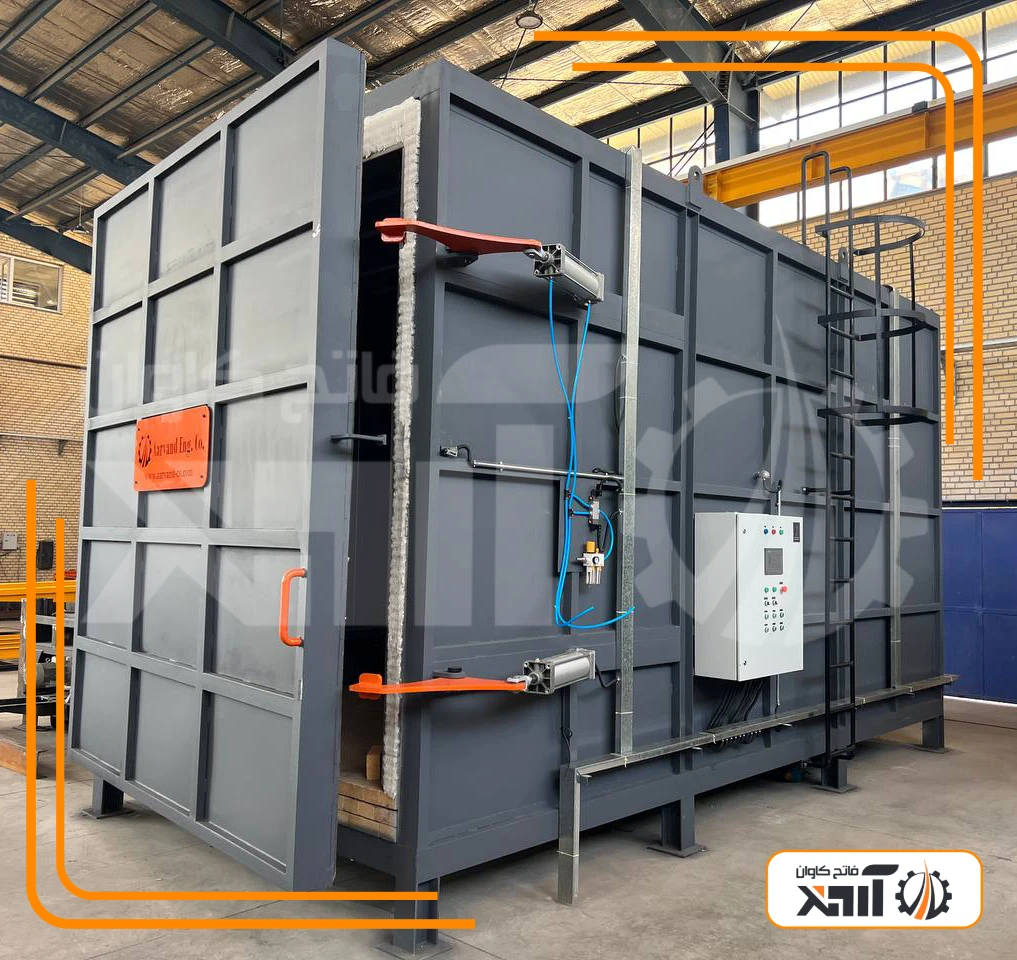
Introduction to the Paint Stripping or Pyrolysis Furnace:
This equipment is used to remove paint, resin, and combustible polymer materials from metal surfaces without producing the slightest environmental pollution. Typical applications include stripping paint from hooks and fixtures used in electrostatic paint lines, as well as cleaning skids and fixtures in the automotive industry.
The pyrolysis furnace is a gas-fired burner type furnace and can be manufactured with customized internal dimensions according to requirements.
The paint stripping (pyrolysis) furnace consists of two thermal chambers: the main furnace chamber and a secondary chamber located above the furnace, designed to completely burn the smoke generated in the main chamber.
The furnace also has two heating zones. The internal temperature is controlled by automatic devices with intelligent control capability. Two Type K thermocouples are used to measure the internal temperature of the pyrolysis furnace. For insulation, ceramic fibers with low density and good thermal insulation properties are used to minimize heat transfer.
Main Components of the Paint Stripping Furnace:
Controlled water spray system that regulates the amount of steam generated.
Explosion relief door that releases excess pressure and vapors by opening and closing.
Carbon dioxide and steam exhaust door generated during the process.
Secondary burner that raises the vapor temperature to 1400°F within 1–2 seconds, ensuring that the vapors are completely burned before being released into the atmosphere.
Water spray system.
Indicator panel that activates different sections of the system and assists in monitoring and controlling the process.
Primary burner that transfers heat beneath the unit so the metal parts heat up and the volatile organic materials decompose and are expelled as vapor gases. The burner flame is confined to the combustion chamber and never comes into contact with the parts.
Fuel supply line (natural gas, fuel oil, etc.).
Rails used for easy loading and unloading along movable tracks.
Furnace floor, designed for easy ash removal and reinforced with durable steel.
Main control box, including temperature indicators, the main power safety switch, and other control components.
Fully welded heavy‑steel cabinet, with sealed joints to prevent leakage.
Doors capable of opening up to 270 degrees.
Walls, ceiling, and doors insulated with double-layer lightweight ceramic fiber.